Choosing Biodegradable Bags in 2026 requires more than trusting a green label. A bag may look responsible while failing under real disposal conditions. The right choice depends on materials, performance, certifications, and local waste systems. It also depends on how the bag will actually be used.
Consider a grocery bag carrying wet vegetables, a courier pouch exposed to rain, or a bin liner holding food scraps. Each application needs different strength, thickness, moisture resistance, and sealing quality. Ask suppliers for complete material descriptions, laboratory test results, and current third-party certifications. Check whether claims match recognized standards in your target market. Marketing language alone is weak evidence.
Disposal conditions matter greatly. Some Biodegradable Bags require controlled industrial composting facilities, while others may not break down effectively in home compost or ordinary landfill environments. Verify the required temperature, humidity, processing time, and collection route. Otherwise, a well-intended purchase may create confusion for customers and waste workers.
Look closely. Avoid vague promises.
A reliable supplier should explain the bag’s end-of-life pathway, production controls, and test limitations. Request samples, then test them with the intended load. A bag that tears beside a delivery vehicle is not a sustainable success. Cost, shelf life, printing inks, and storage conditions also deserve attention. One uncomfortable point remains: biodegradability does not automatically make a product environmentally superior. Reusable options may perform better in some situations. The answer should come from evidence, not fashionable wording. This guide offers a practical framework for comparing choices carefully, while recognizing that standards, infrastructure, and supplier claims may change during 2026.
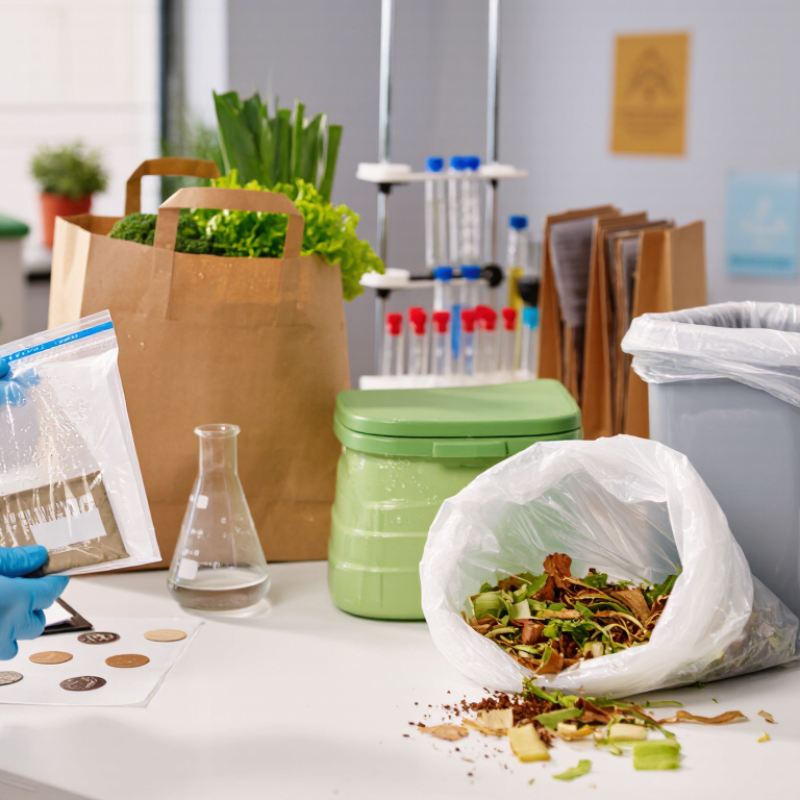
Choosing a biodegradable bag in 2026 starts with a precise definition. Under EN 13432, biodegradation means at least 90% conversion into carbon dioxide within six months. The test uses controlled industrial composting conditions. It does not prove breakdown in soil, seawater, or a household compost bin. That distinction matters.
EN 13432 also examines disintegration, compost quality, and harmful substances. A compliant bag should disintegrate within 12 weeks under testing conditions. Its compost must show no damaging effects on plants.
Ask suppliers for the certificate, laboratory report, and tested product thickness. Resin alone is not enough. Additives and inks can change performance.
Industry data adds useful context. European Bioplastics reported global bioplastics production capacity of about 2.47 million tonnes in 2024, potentially reaching 5.73 million tonnes by 2029. More materials are entering the market. More confusion follows.
A 2023 UNEP report also identified packaging as a major driver of single-use plastic demand. Therefore, check the disposal route before choosing the bag. Industrial composting access may be limited locally. That weakness is easy to overlook.
I would treat “biodegradable” as an unverified marketing word until EN 13432 evidence, end-of-life instructions, and local collection options align.
How to Choose Biodegradable Bags in 2026?
A biodegradable bag needs evidence, not green-colored packaging. ASTM D6400 certification shows that a product meets controlled industrial composting requirements. Check the certificate number, product thickness, additives, and exact bag structure. ASTM D6400 testing commonly examines biodegradation, disintegration, and material safety within defined laboratory conditions. A certificate for one film may not cover every size or printed version.
EN 13432 adds a strict 12-week disintegration rule. At least 90% of the packaging should break into pieces smaller than two millimeters during industrial composting. Biodegradation must also reach 90% within six months under specified conditions. This is not a home-composting promise. Temperature, oxygen, moisture, and microbial activity matter. The European Bioplastics and nova-Institute market report estimated global bioplastics production at about 2.47 million tonnes in 2024. More materials are entering the market, but certification quality still varies.
Ask suppliers for complete laboratory reports, not only a certificate image. Confirm whether the test covered inks, handles, adhesives, and closures. The uncomfortable detail is that a compliant bag may still fail in a cold or poorly managed composting site. Waste-management data from international environmental agencies repeatedly shows that collection and processing systems determine real-world outcomes. I would also record the certification date, because documents can outlive product formulas. My checklist is useful, but not perfect. Field conditions remain the hardest gap.
| Evaluation Dimension | What the Standard or Test Means | Evidence to Request | Buying Decision |
|---|---|---|---|
| Applicable standard | ASTM D6400 is a specification for plastics designed to be composted in municipal and industrial aerobic composting facilities. EN 13432 is the European framework for packaging recoverable through industrial composting and biodegradation. | A current certificate or conformity statement that names the exact bag material, construction, thickness range, and intended composting conditions. | Select a bag evaluated against the standard required in the country and by the composting facility where it will be used. |
| EN 13432 disintegration time | Under controlled industrial-composting test conditions, at least 90% of the packaging material should pass through a 2 mm sieve within 12 weeks, subject to the standard’s test method and sample preparation. | Laboratory test results showing the test duration, temperature, composting method, sample mass, and percentage passing the 2 mm sieve. | Treat “12-week disintegration” as an industrial-composting performance requirement, not a promise that the bag will disappear in a garden, landfill, river, or ocean. |
| Biodegradation requirement | EN 13432 generally requires at least 90% conversion of the organic carbon into carbon dioxide within six months under the specified controlled composting test. Disintegration and biodegradation are separate assessments. | A biodegradation report based on measured carbon dioxide evolution, with the reference material, duration, and pass result identified. | Do not accept “breaks into small pieces” as proof of biodegradation; request carbon-conversion test data. |
| ASTM D6400 verification | ASTM D6400 addresses disintegration during composting, biodegradation, and the potential impact of the material or residues on compost quality. Exact test requirements depend on the edition and certification program used. | The standard number and edition, independent laboratory report, certificate scope, and confirmation that the tested formulation matches the supplied bags. | Reject documents that only mention “ASTM testing” without identifying ASTM D6400 and the complete product scope. |
| Industrial versus home composting | ASTM D6400 and EN 13432 are primarily associated with controlled industrial or municipal composting conditions. Home composting has lower and more variable temperatures and is not automatically demonstrated by either claim. | A separate home-compostability test or certification if disposal in a home compost bin is an intended use. | Choose “industrially compostable” only when a suitable commercial collection and processing route is available. |
| Compost ecotoxicity | EN 13432 includes an assessment intended to show that the resulting compost does not create unacceptable negative effects on plant growth. Disintegration alone does not prove compost safety. | Phytotoxicity or compost-quality test results, including the test organism or plant-growth method and pass criteria. | Prefer products with documented ecotoxicity results rather than relying only on material names such as “plant-based” or “bio-based.” |
| Heavy metals and regulated substances | Compostability requirements include limits for specified elements and must also consider residues, inks, additives, adhesives, and other components of the finished bag. | A finished-product declaration or laboratory report covering the complete bag, including printing inks, colorants, handles, labels, and adhesive layers. | Evaluate the finished article, not only the resin or film used to manufacture it. |
| Food-contact suitability | Compostability and food-contact compliance are different claims. A bag can meet a compostability specification without being suitable for direct food contact. | Food-contact declaration and applicable migration test results for the destination market, if the bag will touch food. | Require both approvals when the intended use involves food contact, fresh produce, or unpackaged ingredients. |
| Intended waste stream | A certified compostable bag still requires the correct collection system. Many facilities do not accept compostable plastic bags, and local rules may prohibit them in organic-waste bins. | Written acceptance guidance from the receiving composting facility or local waste authority. | Confirm disposal infrastructure before purchase; certification cannot replace local acceptance. |
| Claim quality and traceability | Terms such as “biodegradable,” “eco-friendly,” “ degradable,” or “made from plants” do not independently establish ASTM D6400 or EN 13432 compliance. | Certificate number, issuing organization, test laboratory, issue date, expiry or surveillance status, product identification, and batch or formulation traceability. | Give priority to specific, independently verifiable claims tied to the exact finished bag. |
Reference framework: ASTM D6400, Standard Specification for Labeling of Plastics Designed to be Aerobically Composted in Municipal or Industrial Facilities; EN 13432, Packaging—Requirements for Packaging Recoverable through Composting and Biodegradation.
A biodegradable bag should match its tensile performance to the real load, not just its label. ISO 527 provides methods for measuring plastic tensile properties under controlled conditions. Request results for tensile strength, elongation at break, and tensile modulus. Ask whether the laboratory used ISO 527-1 and the relevant film method, such as ISO 527-3. Film direction matters. A bag may perform differently along the machine direction and cross direction. Thickness, humidity, specimen shape, conditioning time, and test speed should appear on the report. Without these details, comparisons can become misleading.
Test the complete bag too. A film can show strong ISO 527 results yet fail at a handle or side seam. Match the data to the expected load, sharp edges, stacking time, and moisture exposure. A bag carrying five kilograms of boxed goods needs more than five kilograms of nominal tensile strength. Handling creates sudden pulls, while seams concentrate stress. Keep a practical safety margin, and consider puncture and tear testing when contents have corners.
Biodegradable materials may also lose strength after heat or prolonged humidity. I have seen specifications focus too heavily on material strength and overlook closure design. That is a useful warning. Test samples in realistic conditions, including filled bags hanging for several hours. Small details often decide whether the bag survives.
A bag marked biodegradable may sound suitable for every compost pile. It is not that simple. Industrial composting usually maintains about 58°C, controlled moisture, regular aeration, and active microbial conditions. These systems process materials faster and more consistently than household compost bins.
A home compost pile often stays cooler. Temperatures may change after rain, during winter, or when food scraps are unbalanced. Therefore, a bag designed for industrial composting may leave fragments in your backyard compost. Look for clear wording such as home compostable, supported by recognized testing. “Compostable” alone is too vague.
Check the disposal route before buying. Ask your local waste collector whether certified compostable bags are accepted. Some facilities reject them because staff cannot easily separate them from conventional plastic. This practical detail matters more than attractive packaging claims. The correct temperature is only one part of the process.
I once assumed a thinner bag would break down faster. That was an oversimplification. Material chemistry, thickness, moisture, and compost conditions all influence decomposition. A reliable supplier should provide testing details, intended composting conditions, and clear disposal instructions. If those details are missing, choose cautiously. A bag that performs well in an industrial tunnel may fail beside your garden tomatoes.
Choosing biodegradable bags in 2026 requires more than reading the word “biodegradable.” UNEP estimates that people generate about 430 million tonnes of plastic waste each year. That figure makes every material choice feel consequential, even for a small shopping bag. Examine the full life cycle: raw materials, factory energy, transport, bag strength, and disposal conditions.
A plant-based bag may reduce fossil resource use, but production can still require land, water, fertilizers, and energy. A fossil-based biodegradable bag may perform well, yet offer fewer climate benefits than expected. The label alone misleads. Check independent test evidence, material composition, and the exact conditions needed for decomposition. Some bags break down only in controlled industrial composting facilities. They may remain unchanged in soil, seawater, or a household compost bin.
In practical purchasing reviews, I would compare weight and reuse potential before choosing a thinner replacement. A durable bag used several times can reduce material demand. However, reuse depends on strength, hygiene, and realistic consumer behavior. This is where simple comparisons become imperfect. I once treated disposal as the final step, but transport to a distant facility also affects the result. Ask whether local waste systems can process the bag. Consider certified compostability only when suitable collection exists. Measure actual performance, not attractive claims.
Compare life-cycle context with UNEP’s estimate of approximately 430 million tonnes of plastic waste generated each year.
Biodegradable does not automatically mean low-impact: the result depends on raw materials, production energy, transport, reuse potential, and whether suitable industrial composting exists. OECD data for 2019 indicate that only about 9% of global plastic waste was recycled, while approximately 22% was mismanaged. The 430-million-tonne figure is a separate UNEP estimate of annual plastic waste generation and should be used as a scale reference rather than combined directly with the OECD waste-fate percentages.
Sources: United Nations Environment Programme, Turning off the Tap (2023); OECD, Global Plastics Outlook (2022).